
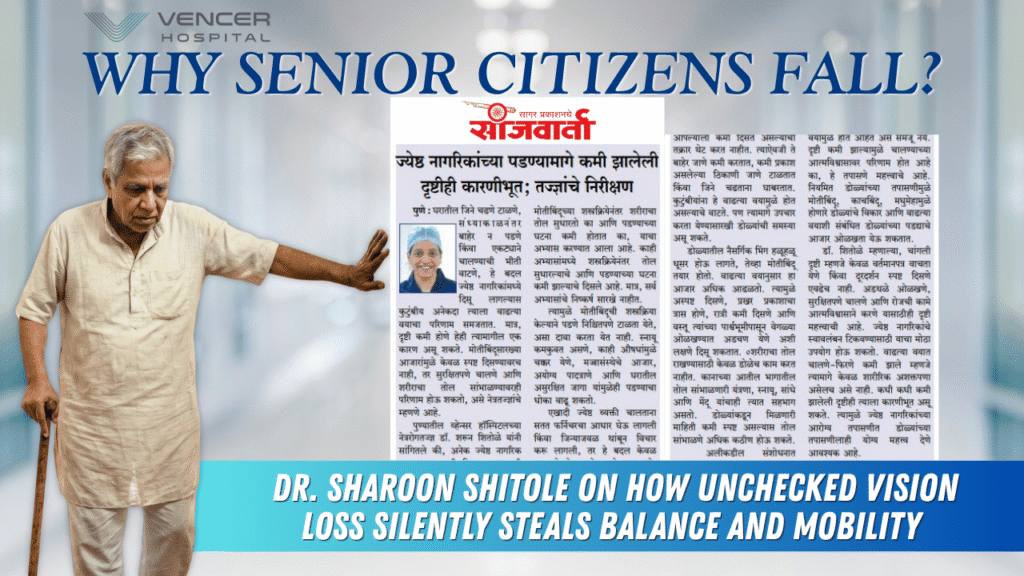
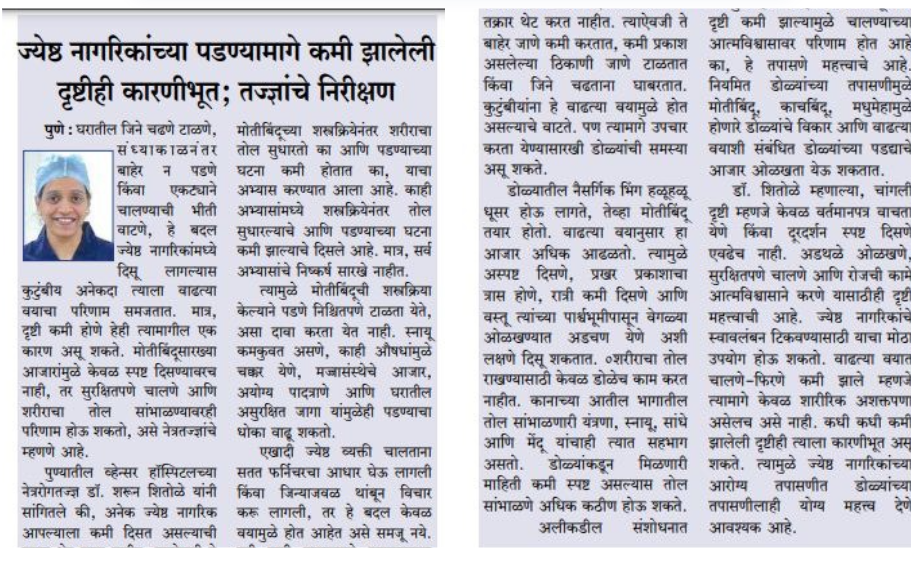
In an expert health feature published by Sanjvarta (26 October 2026, Page 2), Dr. Sharoon Shitole, Managing Director and Consultant Ophthalmologist at Vencer Hospital, sheds light on a frequently overlooked contributor to elderly injuries: declining visual acuity and contrast sensitivity. When seniors hesitate on stairs, hold furniture while walking, or refuse evening outings, the root issue is often not muscular fatigue—it is a treatable eye condition like cataracts that robs them of spatial confidence.
Falls among senior citizens are widely dismissed as an inevitable consequence of aging or physical frailty. However, clinical ophthalmology reveals that vision is an indispensable pillar of bodily equilibrium, working in sync with the inner ear, spinal sensory nerves, and brain. Conditions like cataracts, glaucoma, and macular degeneration diminish contrast perception and depth judgment long before central vision disappears. Identifying and treating visual impairment restores walking confidence, reduces hesitation on stairs, and plays a crucial preventive role in senior fall management.
The Hidden Behavioral Clues Families Mistake for "Ageing"
According to Dr. Sharoon Shitole, older adults rarely report blurriness outright. Instead, they subtly alter their daily routines to compensate for degraded visual perception:
- Hesitation and Pausing at Stairs: Struggling to distinguish where one step ends and the next begins due to reduced contrast sensitivity and impaired depth perception.
- “Furniture Walking” (Cruising): Continuously running hands along walls, tables, and chair backs when navigating familiar rooms at home.
- Avoidance of Dimly Lit Spaces and Evenings: Reluctance to step outdoors after sunset or entering hallways with subtle lighting differences.
- Gradual Social Withdrawal: Declining invitations to visit relatives, temples, or community walks due to an unspoken fear of stumbling or losing balance.
How Vision Directly Regulates Postural Balance
Human balance is not maintained by legs and joints alone. The brain triangulates real-time spatial positioning using three interdependent inputs:
- Visual Cues (Eyes): Tracking horizons, floor transitions, shadows, and upcoming physical obstacles.
- Vestibular System (Inner Ear): Detecting head orientation and linear acceleration.
- Proprioception (Muscles & Joints): Sensing foot pressure against the ground and joint angles.
When cataracts cause the natural crystalline lens to turn cloudy, the clarity of optical input degrades. The brain is forced to navigate on incomplete data, drastically impairing reactionary footing when a seniorencounters uneven flooring, door thresholds, or loose rugs.
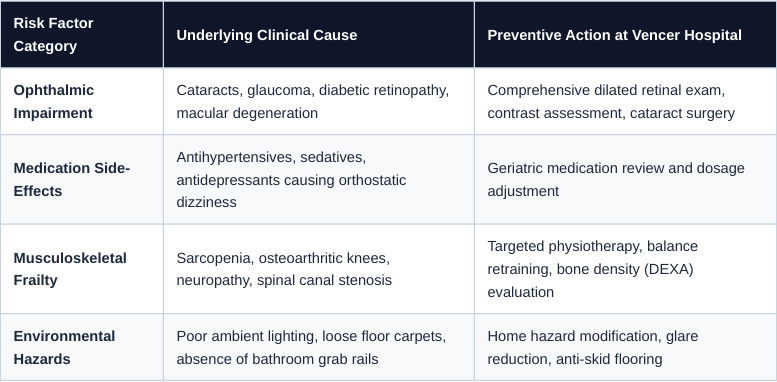
Multifactorial Fall Risks in Senior Citizens
Does Cataract Surgery Eliminate the Risk of Falling?
Dr. Shitole points out that clinical research presents an honest, balanced reality: while restoring visual sharpness through cataract surgery has been shown in multiple studies to improve balance and significantly decrease fall frequency, it is not a standalone guarantee against every fall. Because aging involves muscle strength, medication interactions, inner ear vestibular health, and environmental hazards, fall prevention requires an integrated, comprehensive approach.
“Clear vision isn’t just about reading a newspaper or watching television,” notes Dr. Shitole. “It is about recognizing obstacles, stepping over thresholds securely, and maintaining the dignity of self-reliant living.”
Press Reference: As featured in the Marathi daily newspaper Sanjvarta, Pune edition (26 October 2026, Page 2)
Specialized Ophthalmic Care at Vencer Hospital, Pimple Nilakh
Led by Dr. Sharoon Shitole, the Ophthalmology Department at Vencer Hospital delivers advanced corneal diagnostics, dry-eye therapies, and modern surgical solutions.
• Hospital Location: Vencer Hospital, Opposite Savitribai Phule Udhyan, Pimple Nilakh, Pune
• OPD Appointments: +91 80559 15591 | Website: www.vencerhospital.com
Frequently Asked Questions (FAQ)
Q: Can poor eyesight cause an elderly person to lose balance and fall?
A: Yes. The brain relies heavily on visual information to coordinate posture and footing. Conditions like cataracts and macular degeneration diminish contrast sensitivity and depth perception, making it difficult to judge steps, curbs, and shadows, leading to trips and loss of balance.
Q: What are the warning signs that vision problems are affecting an elder's walking?
A: Key behavioral signs include pausing nervously at staircases, touching furniture or walls for support while walking indoors, refusing to leave the house after dusk, and dragging feet over minor floor transitions.
Q: Why do diabetic patients need retinal imaging even if their vision is clear?
A: In many cases, yes. By replacing the cloudy natural lens with a clear artificial lens, cataract surgery sharpens spatial orientation and contrast discrimination. However, it should be paired with physical therapy and home hazard modification for total fall prevention.