
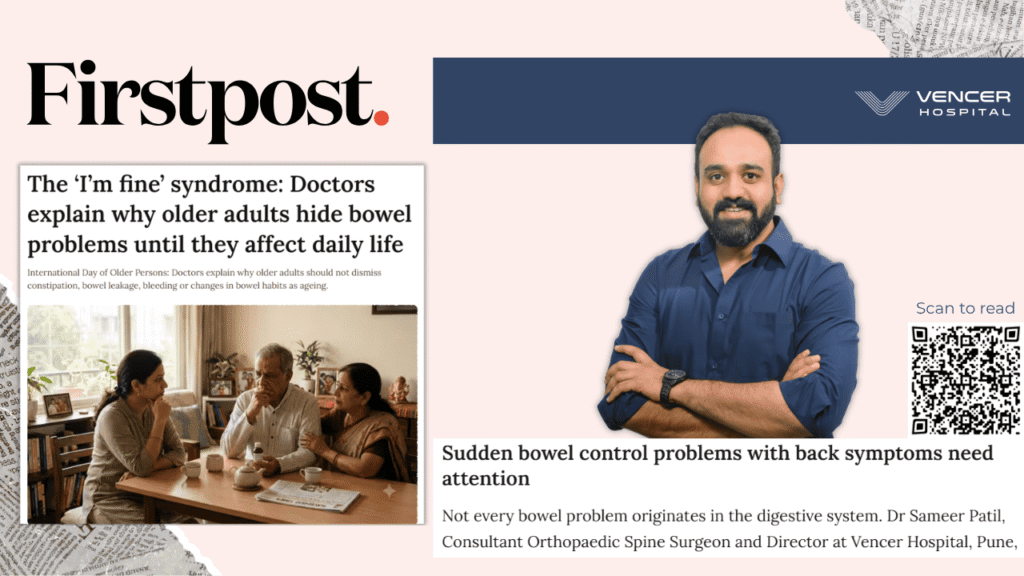
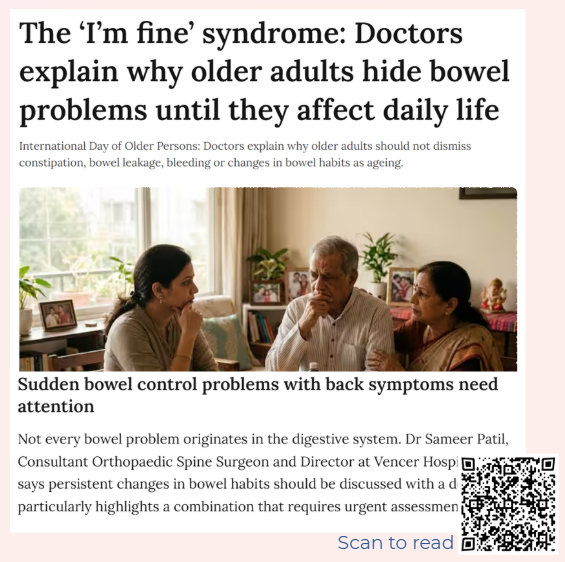
On the International Day of Older Persons, national news platform Firstpost published an investigative health report examining the “I’m Fine” syndrome—a common tendency among older adults to conceal embarrassing bowel symptoms. Representing Vencer Hospital, Director and Consultant Orthopaedic Spine Surgeon Dr. Sameer Patil joined leading medical experts to highlight a vital clinical distinction: why sudden bowel issues paired with back pain are often neurological emergencies, not just digestive troubles.
While bowel irregularities in older adults are frequently attributed to dietary changes, low hydration, or pelvic floor weakness, not every bowel issue originates in the gut. As Dr. Sameer Patil explains in Firstpost, the sudden loss of bowel control accompanied by severe back pain, new leg weakness, or numbness in the groin and saddle region indicates severe compression of the lower spinal nerves (Cauda Equina Syndrome). This neurological red flag requires urgent surgical evaluation within hours to prevent permanent dysfunction.
Key Insights from the Firstpost Feature
- The “I’m Fine” Barrier: Between 10% and 30% of older adults suffer from chronic constipation, piles, fissures, or leakage, but frequently suffer in silence due to embarrassment or the mistaken belief that these symptoms are an inevitable part of aging.
- Lifestyle Isolation: Hidden bowel issues often manifest through behavioral withdrawal—such as refusing to travel, avoiding social gatherings, or hesitating before routine family outings.
- The Paradox of Fecal Impaction: Severe constipation can paradoxically present as loose stool or leakage around impacted matter, misleading families into treating it as simple diarrhea.
- Medication Culprits: Routine geriatric prescriptions—including opioid analgesics, calcium and iron
supplements, certain antihypertensives, and antidepressants—frequently worsen bowel sluggishness.
Spine Red Flag Highlighted by Dr. Sameer Patil:
“Sudden loss of bowel control along with severe back pain, new leg weakness, or numbness around the groin or saddle region is particularly concerning,” states Dr. Sameer Patil. This combination points directly
toward acute compression of the lower spinal cord nerve roots (Cauda Equina Syndrome) and demands emergency neuro-spine decompression.
To read the full investigative story on Firstpost discussing bowel health and elderly care, visit:
When Should Families Seek Immediate Spine Care?
Dr. Sameer Patil advises families and caregivers never to evaluate digestive symptoms in total isolation if they coincide with musculoskeletal warning signs:
- Sudden Incontinence or Urinary Retention: An abrupt inability to hold or release bowel movements or urine.
- Saddle Anesthesia: Loss of sensation or numbness between the thighs, buttocks, and perineal region.
- Progressive Leg Weakness or Foot Drop: Stumbling, unsteady gait, or dragging of the toes while walking.
- Radiating Sciatica: Sharp, shooting pain traveling from the lower back down both legs simultaneously.
Frequently Asked Questions (FAQ)
Q: Can a lower back spinal problem cause loss of bowel control?
A: Yes. The cauda equina is a bundle of nerve roots located at the lower end of the spinal cord that supplies motor and sensory signals to the bladder, bowel, and pelvic organs. Severe disc herniation or spinal stenosis compressing these nerves directly impairs bowel sphincter control.
Q: What is Cauda Equina Syndrome, and why is it an emergency?
A: Cauda Equina Syndrome occurs when the lower spinal nerve roots are severely squeezed. It is considered a true surgical emergency because delay in surgical decompression can lead to permanent paralysis of the lower limbs and permanent loss of bowel and bladder function.
Q: How can families help elderly relatives overcome the "I'm Fine" syndrome?
A: Watch for subtle behavioral changes, such as reluctance to travel, prolonged bathroom visits, or avoiding social gatherings. Approach the subject with empathy, emphasizing that bowel and mobility problems are common, treatable medical conditions rather than embarrassing personal failures.
VENCER HOSPITAL, PUNE • SPINE SURGERY LEADERSHIP PROFILE
Dr. Sameer Patil
MBBS, MS (Ortho), Fellowship in Spine Surgery • Director & Consultant Spine Surgeon
- Minimally Invasive Spine Surgery (MISS)
- Lumbar & Cervical Disc Herniation & Stenosis
- Spinal Decompression & Cauda Equina Care
- Deformity Correction & Geriatric Spine Health
Appointments: +91 80559 15591 | Web: www.vencerhospital.com