
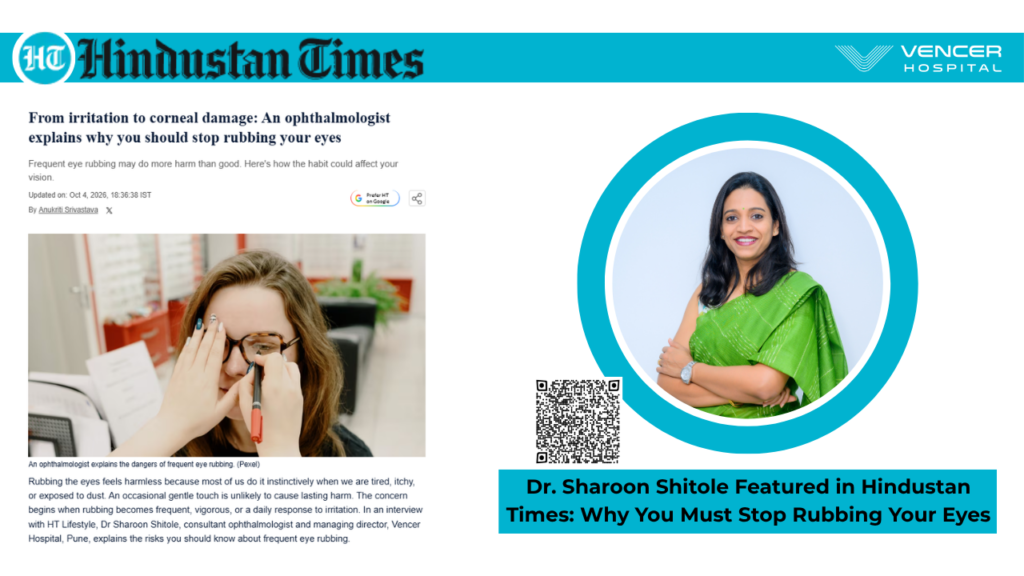
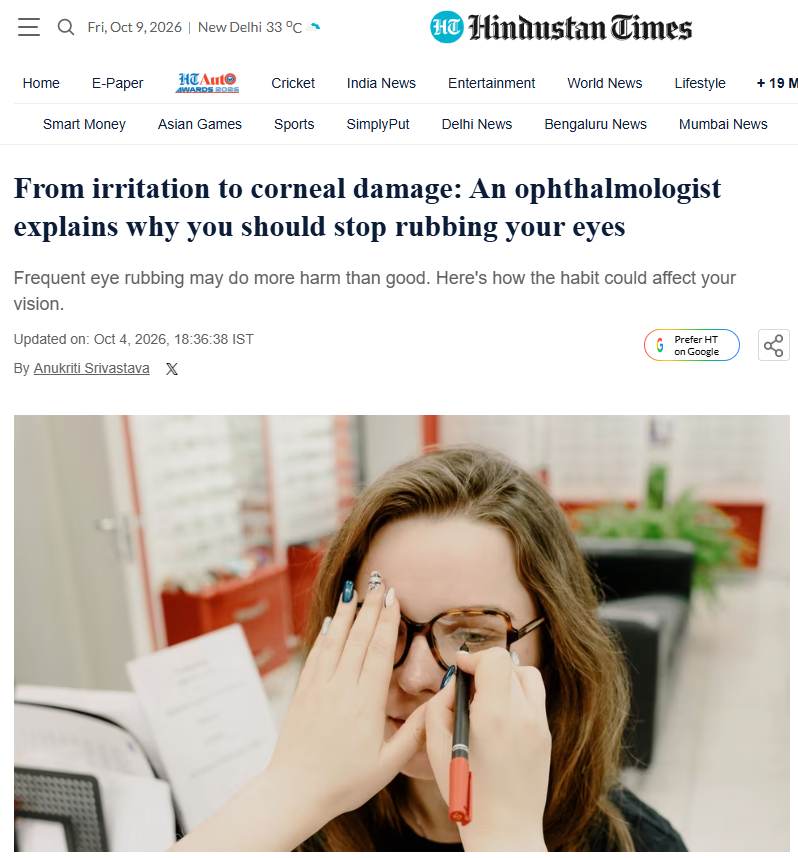
A Proud Milestone for Vencer Hospital We take immense pride in announcing that our Managing Director and Consultant Ophthalmologist, Dr. Sharoon Shitole, was recently featured as the expert authority in Hindustan Times! In this national coverage, she discusses the clinical risks of a seemingly harmless everyday reflex—explaining how vigorous, repetitive eye rubbing can lead to progressive corneal damage and permanent vision impairment.
Frequent or aggressive eye rubbing exposes the cornea to severe
mechanical stress, dramatically increasing the risk of keratoconus—a condition where the cornea thins and bulges into a cone shape. In her Hindustan Times feature, Dr. Sharoon Shitole emphasizes that instead of rubbing, patients must address the underlying clinical triggers, such as ocular allergies, dry eye disease, or digital screen strain, to prevent irreversible vision loss.
Key Insights from Dr. Sharoon Shitole’s Feature in Hindustan Times
- Mechanical Stress on the Cornea: The clear front window of the eye is not built to withstand repetitive physical pressure. Chronic rubbing breaks down structural tissue integrity over time.
- Keratoconus and Irregular Astigmatism: Habitual eye rubbing is strongly linked to keratoconus, causing blurred vision, distortion, and rapid changes in cylinder power.
Heightened Risk for Adolescents & Young Adults: Keratoconus typically emerges during adolescence and early adulthood, making habitual eye rubbing among youth particularly dangerous. - Spikes in Intraocular Pressure: Vigorous rubbing causes temporary pressure spikes within the eye and irritates the ocular surface. It is strictly contraindicated for anyone recovering from recent eye surgery.
- Infection Transmission: Hands carry bacteria, viruses, and environmental allergens that rubbing transfers directly onto the eye.
- Treat the Trigger, Not Just the Urge: Persistent itching usually signals allergic conjunctivitis, dry eye syndrome, or screen-related eye strain. Simply attempting to stop the reflex fails unless the root cause
is medically managed. - Immediate Home Relief: A clean, cold compress applied gently over closed eyelids provides safe relief without dangerous mechanical friction.
To explore Dr. Shitole’s full clinical breakdown and quotes, read the complete published story directly on Hindustan Times
When to Seek an Eye Examination?
Dr. Shitole advises scheduling an immediate ophthalmic evaluation if you observe any of these warning
signs
- Frequent changes in your spectacle prescription.
- Rapidly worsening astigmatism or blurred vision that new glasses fail to correct.
- Increased sensitivity to glare or light distortion at night.
Persistent burning, redness, or a foreign-body sensation under the eyelids. - Persistent burning, redness, or a foreign-body sensation under the eyelids
Specialized Ophthalmic Care at Vencer Hospital, Pimple Nilakh
Led by Dr. Sharoon Shitole, the Ophthalmology Department at Vencer Hospital delivers advanced corneal diagnostics, dry-eye therapies, and modern surgical solutions.
• Hospital Location: Vencer Hospital, Opposite Savitribai Phule Udhyan, Pimple Nilakh, Pune
• OPD Appointments: +91 80559 15591 | Website: www.vencerhospital.com
Frequently Asked Questions (FAQ)
Q: Can frequent eye rubbing permanently damage your eyesight?
A: Yes. Chronic, vigorous eye rubbing can cause corneal thinning and irregular bulging (keratoconus), resulting in permanent distortion, high astigmatism, and significant vision loss.
Q: What is the safest way to relieve itchy eyes immediately?
A: Place a clean cold compress or cloth gently over closed eyelids to reduce histamine-driven itching without
applying physical pressure or rubbing.
Q: Why is eye rubbing dangerous after cataract or laser eye surgery?
A: Rubbing exerts mechanical force that can disrupt delicate corneal incisions, displace intraocular implants, or
introduce severe microbial infections into healing ocular tissues.