
Advancing Preventive Orthopaedics & Women's Musculoskeletal Care
Groundbreaking medical research featured on Health and Me and published in Nature Medicine reveals that menopause is far more than a gradual transition—it triggers an abrupt, multi-system biological shift
affecting bones, liver function, and lipid metabolism. At Vencer Hospital, Director and Senior Orthopaedic Surgeon Dr. Bhushan Shitole discusses what these rapid changes mean for women’s skeletal integrity, osteoporosis risks, and joint preservation.
A landmark study analyzing over 300 million lab tests reveals that menopause triggers a rapid, “cliff-like” physiological shift, with bone turnover and estrogen-sensitive markers changing abruptly around the final menstrual period—preceded by ovarian hormone shifts more than a decade earlier. Dr. Bhushan Shitole notes that because estrogen directly preserves bone mineral density and joint cartilage, post-menopausal women face accelerated risks of osteoporosis, micro-fractures, and osteoarthritis unless proactive DEXA screening, targeted nutrition, and strength regimens are implemented early.
Key Scientific Findings from the Research
- A Multi-System Biological “Cliff”: Analyzing data from over 1 million women across 25 years, researchers identified statistically significant, abrupt changes in 52 out of 90 routine lab tests during the menopausal transition—distinguishing it sharply from gradual male aging patterns.
- Hormonal Shifts Begin 10–15 Years Early: Anti-Müllerian hormone (AMH) began rapid decline ~15 years before the final period, followed by follicle-stimulating hormone (FSH) at ~14 years and estradiol at ~12 years.
- Estrogen-Sensitive Systems Take the Impact: Organs and tissues with high estrogen-receptor density —specifically bone matrix, liver metabolism, and lipid regulation—experienced the sharpest decline in protective markers.
- Protective Role of Hormonal Therapies: The study observed that Menopausal Hormone Therapy (MHT) was associated with mitigated physiological disruption, particularly preserving skeletal and metabolic markers.
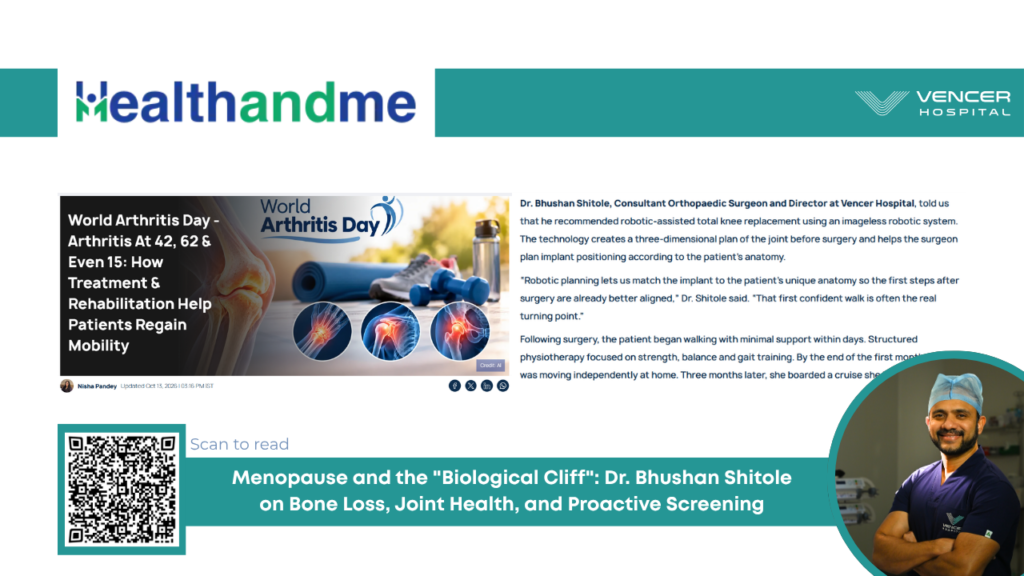
To explore the original study details and computational analysis on Health and Me, access the full feature:
Orthopaedic Perspective: Protecting Bones & Joints Through Menopause
According to Dr. Bhushan Shitole, bone loss during menopause is often “silent” until sudden joint pain, postural kyphosis, or fragility fractures occur. To stay ahead of the biological shift, he recommends:
- Baseline Bone Density (DEXA) Scans: Evaluating bone mineral density (BMD) early identifies osteopenia before it advances to severe osteoporosis.
- Synergistic Calcium & Vitamin D Management: Ensuring adequate 25-hydroxy vitamin D levels
facilitates calcium absorption and maintains muscular stability to reduce fall risks. - Progressive Resistance & Weight-Bearing Exercises: Mechanical loading signals osteoblasts to deposit new bone minerals, counteracting post-menopausal resorption.
- Joint Preservation Strategies: Early evaluation for joint stiffness or knee pain prevents secondary
cartilage degradation and supports long-term mobility.
VENCER HOSPITAL, PUNE • ORTHOPAEDIC LEADERSHIP PROFILE
Dr. Bhushan Shitole
MBBS, MS (Ortho), MCh (Ortho, UK) • Director & Senior Consultant Orthopaedic Surgeon
Clinical Specialties:
- Robotic Joint Replacement & Reconstruction (Hip & Knee)
- Joint Preservation, Cartilage Repair & Sports Medicine
- Metabolic Bone Health, Osteoporosis Care & Trauma
Hospital Location & Consultations:
Vencer Hospital, Opp. Savitribai Phule Udhyan,
Pimple Nilakh, Pune, Maharashtra 411027
Appointments: +91 80559 15591 | Web: vencerhospital.com
Frequently Asked Questions (FAQ)
Q: Why does menopause cause rapid bone loss?
A: Estrogen plays a critical role in slowing down osteoclast activity (cells that break down bone). When estrogen
drops sharply around menopause, bone resorption outpaces bone formation, leading to rapid reductions in bone
mineral density.
Q: Can bone density be restored after menopause?
A: While severe bone loss cannot be completely reversed naturally, bone density can be significantly stabilized and strengthened through targeted antiresorptive medications, calcium and vitamin D optimization, and structured weight
bearing physiotherapy.
Q: When should a woman get her first bone density (DEXA) scan?
A: Women should consider a baseline DEXA scan around perimenopause or by age 50, especially if they have risk factors like early menopause, family history of fractures, low body weight, or persistent back/joint discomfort.