

The earliest signs of a developing spine problem rarely start with severe, agonizing pain; they typically begin with persistent morning stiffness, radiating “pins-and-needles” sensations into the arms or legs, muscle fatigue after brief sitting or standing, and subtle postural shifts. Recognizing these subtle mechanical and neurological indicators allows for non-surgical resolution— such as ergonomic correction and physical therapy—before progressive disc herniation or nerve compression requires surgical intervention.
The 5 Early Warning Signs of Spinal Disorders
Spinal disorders develop gradually through repetitive micro-trauma, postural strain, or disc dehydration. Under the clinical insight of Dr. Sameer Patil, Director and Consultant Spine Surgeon at Vencer Hospital, here are the primary initial signals:
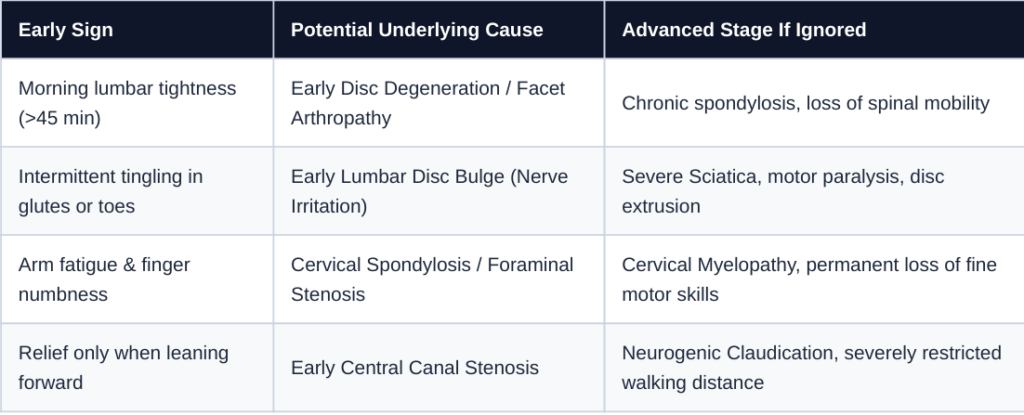
- Persistent Morning Stiffness That Lingers: While momentary tightness after waking is normal, spinal stiffness that takes more than 30–45 minutes to ease often indicates early facet joint arthrosis, disc degeneration, or inflammatory spinal conditions.
- Peripheral Radiating Pain (Radiculopathy): A disc or bone spur irritating an exiting nerve root often causes sensations far from the back itself. Patients frequently experience shooting pain, tingling, or an “electric” current traveling down the buttocks and legs (sciatica) or into the shoulders, arms, and fingers.
- Postural Fatigue & Inability to Stand or Sit Upright: Feeling an involuntary urge to hunch forward, lean on counters, or sit down after standing for just 10–15 minutes is a hallmark sign of early spinal canal narrowing (spinal stenosis) or core muscular exhaustion.
- Subtle Motor Weakness or Clumsiness: Stumbling over small uneven surfaces, subtle foot dragging (early foot drop), or difficulty buttoning a shirt or holding pens can indicate cervical or lumbar nerve pathway compression.
- Pain That Changes with Specific Postures: Back pain that intensifies when bending forward usually indicates disc pathology (such as a bulging disc), whereas pain aggravated by leaning backward typically stems from facet joint wear.
Early Warning Signs vs. Advanced Spinal Conditions
Critical Red Flag Warning:
If early symptoms suddenly escalate into loss of bowel or bladder control, numbness in the saddle/groin area, or rapidly progressing weakness in both legs, this constitutes a surgical emergency known as Cauda Equina Syndrome. Immediate evaluation within hours is necessary to prevent irreversible nerve damage.
When to Consult a Spine Specialist
Early intervention prevents minor postural strain from transforming into structural degeneration. Schedule a spine evaluation if you experience:
- Back or neck pain lasting longer than 2 weeks without relief from rest.
- Numbness, tingling, or weakness that radiates past your knees or elbows.
- Pain that disrupts your sleep or wakes you up when changing positions.
- Frequent episodes where your back “catches” or locks during routine bending.
Dr. Sameer Patil
MBBS, MS (Ortho), Fellowship in Spine Surgery • Director & Consultant Spine Surgeon
Clinical Specialties:
• Minimally Invasive Spine Surgery (MISS)
• Sciatica, Lumbar & Cervical Disc Herniation
• Spinal Decompression & Motion Preservation
• Postural Deformity & Degenerative Spine Management
Appointments: +91 80559 15591 | Web: www.vencerhospital.com
Frequently Asked Questions (FAQ)
Q: How can I tell if my back pain is muscular or spinal?
A: Muscular strain usually feels like an ache or cramp localized to the muscles that improves with gentle stretching and heat within 3–5 days. Spinal issues tend to persist longer, trigger sharp or radiating pains down the limbs, cause numbness/tingling, or worsen with specific spine movements (bending forward or backward).
Q: Can tingling in the fingers be a sign of a spine issue?
A: Yes. Compression of the cervical nerve roots (in the neck) often radiates symptoms down the arm into the hand and fingers, presenting as tingling, numbness, or loss of grip strength.
Q: Do most early spine problems require surgery?
A: No. Over 85–90% of early spinal problems are successfully treated through conservative protocols, including targeted physiotherapy, core stabilization exercises, posture retraining, and anti-inflammatory management.